Quick Answer
- On a 17 inch wheel (432 mm), 1 mm of total toe is 0.066 degrees per wheel (0.133 total), and 0.10 degrees per wheel is 0.75 mm per wheel (1.51 mm total). 1/16 inch of total toe is 0.105 degrees per wheel.
- Toe in mm depends on the diameter measured across. Mevotech says that with linear toe measurements the wheel (rim) size is needed to calculate the angle.
- Positive toe is toe-in. Mevotech says excessive toe-in accelerates wear on the outer tire edges and excessive toe-out wears the inner edges.
Enter a toe value in degrees, mm or inches, per wheel or total. Positive is toe-in, negative is toe-out.
Millimetre toe depends on the diameter you measure across. Mevotech says that with linear toe measurements the wheel (rim) size is needed to calculate the angle.
Toe-in at 17 inch wheel diameter (432 mm)
Per wheel
0.100°
0° 6′ (degrees and minutes)
0.75 mm, 0.030 in
Total (both wheels)
0.200°
0° 12′ (degrees and minutes)
1.51 mm, 0.059 in (1/16 in, nearest 1/32)
Working
mm per wheel = 431.8 x sin(0.100 deg) = 0.754
Your vehicle's toe specification, and whether it is per wheel or total, is in the manufacturer's service information. NHTSA says a wheel alignment maximizes tire life and prevents the car from veering.
Get a plain-English explanation of your results and what they mean for your vehicle.
Toe-In vs Toe-Out
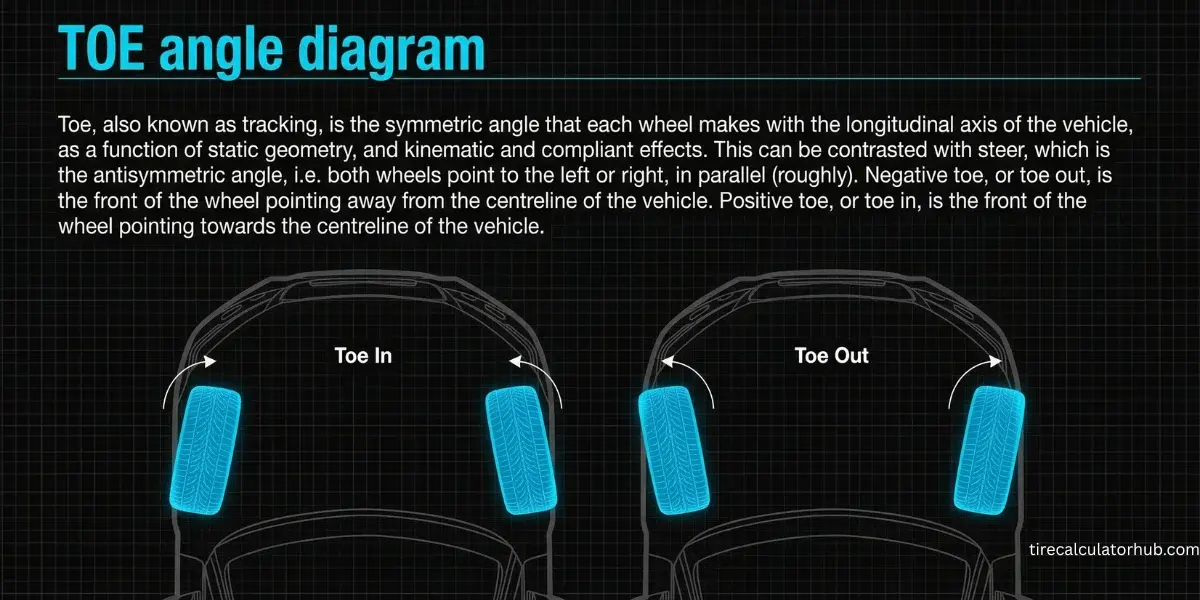
| Setting | From above | Tire wear |
|---|---|---|
| Toe-in (positive) | The fronts of the tires point toward each other, seen from above. | Excessive toe-in accelerates wear on the outer tire edges (Mevotech). |
| Zero toe | The wheels point straight ahead, parallel to each other. | Neither toe-in nor toe-out. |
| Toe-out (negative) | The fronts of the tires point away from each other, seen from above. | Excessive toe-out accelerates wear on the inner tire edges (Mevotech). |
Source: Mevotech, How to Read and Understand a Wheel Alignment Report. The other two alignment angles are on the camber calculator and the caster angle calculator, and the wheel alignment guide covers all three.
Toe Degrees to mm Chart (Wheel Alignment)
Total toe in mm for both wheels together, from the angle per wheel, for common wheel diameters.
| Toe per wheel | 15 in | 16 in | 17 in | 18 in | 19 in | 20 in |
|---|---|---|---|---|---|---|
| 0.02° | 0.27 | 0.28 | 0.30 | 0.32 | 0.34 | 0.35 |
| 0.05° | 0.66 | 0.71 | 0.75 | 0.80 | 0.84 | 0.89 |
| 0.10° | 1.33 | 1.42 | 1.51 | 1.60 | 1.68 | 1.77 |
| 0.15° | 1.99 | 2.13 | 2.26 | 2.39 | 2.53 | 2.66 |
| 0.20° | 2.66 | 2.84 | 3.01 | 3.19 | 3.37 | 3.55 |
| 0.25° | 3.32 | 3.55 | 3.77 | 3.99 | 4.21 | 4.43 |
| 0.30° | 3.99 | 4.26 | 4.52 | 4.79 | 5.05 | 5.32 |
| 0.50° | 6.65 | 7.09 | 7.54 | 7.98 | 8.42 | 8.87 |
| 1.00° | 13.30 | 14.19 | 15.07 | 15.96 | 16.85 | 17.73 |
Toe mm and inches to degrees
Total toe in mm or inches, and the angle it gives per wheel, by wheel diameter.
| Total toe | 15 in | 16 in | 17 in | 18 in | 19 in | 20 in |
|---|---|---|---|---|---|---|
| 0.5 mm | 0.038° | 0.035° | 0.033° | 0.031° | 0.030° | 0.028° |
| 1 mm | 0.075° | 0.070° | 0.066° | 0.063° | 0.059° | 0.056° |
| 1.5 mm | 0.113° | 0.106° | 0.100° | 0.094° | 0.089° | 0.085° |
| 2 mm | 0.150° | 0.141° | 0.133° | 0.125° | 0.119° | 0.113° |
| 3 mm | 0.226° | 0.211° | 0.199° | 0.188° | 0.178° | 0.169° |
| 4 mm | 0.301° | 0.282° | 0.265° | 0.251° | 0.237° | 0.226° |
| 5 mm | 0.376° | 0.352° | 0.332° | 0.313° | 0.297° | 0.282° |
| 6 mm | 0.451° | 0.423° | 0.398° | 0.376° | 0.356° | 0.338° |
| 1/32 in (0.79 mm) | 0.060° | 0.056° | 0.053° | 0.050° | 0.047° | 0.045° |
| 1/16 in (1.59 mm) | 0.119° | 0.112° | 0.105° | 0.099° | 0.094° | 0.090° |
| 3/32 in (2.38 mm) | 0.179° | 0.168° | 0.158° | 0.149° | 0.141° | 0.134° |
| 1/8 in (3.17 mm) | 0.239° | 0.224° | 0.211° | 0.199° | 0.188° | 0.179° |
| 3/16 in (4.76 mm) | 0.358° | 0.336° | 0.316° | 0.298° | 0.283° | 0.269° |
| 1/4 in (6.35 mm) | 0.477° | 0.448° | 0.421° | 0.398° | 0.377° | 0.358° |
Degrees are per wheel; double them for the total angle. Fractions such as 1/16 in are 1/16 inch.
How Toe Is Calculated, Measured and Set
Degrees to mm (per wheel)
mm = wheel diameter x sin(angle). For 0.10 degrees on 17 inch (431.8 mm): 431.8 x sin(0.10) = 0.754 mm.
mm to degrees (per wheel)
angle = asin(mm / wheel diameter). For 0.5 mm per wheel on 17 inch: asin(0.5 / 431.8) = 0.066 degrees.
Per wheel and total
Total toe is both wheels together, so total = 2 x per wheel. A specification of +0.20 degrees total is +0.10 degrees per wheel. Check which your specification means.
Inches and fractions
Divide inches by 0.03937 for mm, or multiply by 25.4. 1/16 inch = 1.59 mm. The calculator rounds the total to the nearest 1/32 inch.
| Topic | What Mevotech says |
|---|---|
| Units | Toe compares the distances between the front and rear on a pair of tires, in plus or minus degrees, and is sometimes given in linear mm or inches. With linear measurements the wheel (rim) size is needed to calculate the angle. |
| Adjusting toe | Toe is set by changing the length of the tie rod assembly. When the assembly is behind the pivot point, shorten it to toe-out and lengthen it to toe-in. |
| Order of adjustment | In a front-end or four-wheel alignment, check the thrust line, set caster, then camber, then toe. |
| Specifications | Specifications come from the vehicle service manual and are defined by make, model, trim and tire size. Adjustments should split the difference between the minimum and maximum specification. |
| When it is needed | After new tires, replaced steering or suspension parts, drift, pull or off-center steering, irregular tire wear, or a hard impact. |
Source: Mevotech, How to Read and Understand a Wheel Alignment Report. NHTSA says a wheel alignment maximizes the life of your tires and prevents the car from veering.
How to Use the Toe Calculator
- 1Enter the toe value from your alignment specification or measurement, and choose degrees, millimetres or inches.
- 2Choose whether the value is per wheel or the total for both wheels.
- 3Set the wheel diameter in inches (the rim size, as Mevotech says linear toe depends on it).
- 4Read the angle and the linear toe per wheel and in total, in mm, inches and the nearest 1/32 inch.