Quick Answer
- Going from ET49 to ET35 raises scrub radius by 14 mm (calculated: factory ET minus new ET).
- A 15 mm spacer on an ET45 wheel is the same as ET30 and adds 15 mm.
- Full formula: SR = (spindle offset − ET) − tire radius × tan(SAI). A tire diameter change of 20 mm shifts it by about 2 mm.
Enter your factory and new wheel offset to see how scrub radius shifts. No SAI data needed, only your ET values.
Stamped on your wheel.
Stamped on the aftermarket wheel (e.g. ET35, ET25).
A spacer reduces effective ET by the same amount. 15 mm spacer on ET45 = effective ET30. Stacks with the new wheel ET above.
Optional: Tire Diameter Change
Leave blank if only changing wheels. If both diameters are filled, an adjustment is calculated using an assumed 12° SAI.
Selects the note shown with the result.
How to Use This Calculator
- 1Choose Mode 1 (Quick Delta) if you only have your factory and new wheel ET values. No SAI data is needed.
- 2Choose Mode 2 (Full Geometry) if you have your vehicle's SAI/KPI angle and spindle offset from manufacturer data or an alignment printout.
- 3In Mode 1, enter the factory ET and the new wheel ET. Add a spacer thickness if you are fitting one, and the old and new tire diameters if the tire size changes.
- 4In Mode 2, enter SAI (degrees), spindle offset (mm), wheel ET (mm) and overall tire diameter (mm).
- 5Read the result: the calculator shows the scrub radius or its change, and the sign (positive, negative or zero).
- 6Ask the vehicle manufacturer or a dealer whether the wheel offset is approved for your vehicle.
Formula Reference
Mode 1: Quick Delta (ET-based)
ΔSR = (Factory ET − New ET) − (ΔTire Diameter / 2) × tan(SAI)

Without a tire size change:
  ΔSR = Factory ET − New ET
  (1 mm less offset = +1 mm scrub radius)

The tire term uses an assumed 12° SAI.
Tire width does not change the contact patch center on the same
wheel, so there is no tire width term.
Mode 2: Full Geometry (SAI-based)
SR = (Spindle Offset − ET) − (Tire Radius × tan(SAI))

Where:
  Spindle Offset = distance from the hub mounting face to the
                   steering axis at hub height, measured inboard
  ET             = wheel offset in mm (stamped on the wheel)
  Tire Radius    = overall tire diameter / 2 (mm)
  SAI            = Steering Axis Inclination in degrees

Sign convention used here:
  Positive SR: steering axis meets the ground inboard of the
               contact patch center
  Negative SR: steering axis meets the ground outboard of it
ΔSR = Factory ET − New ET
Every 1 mm reduction in wheel offset = +1 mm scrub radius. Every 1 mm spacer = +1 mm scrub radius.
Scrub Radius Change by Wheel Offset and Spacer
All values are calculated with the formulas above, not published figures. A positive change moves the contact patch center outward relative to the steering axis.
Wheel offset (ET) swaps
| Factory ET | New wheel ET | Spacer | Effective ET | Scrub radius change | In inches |
|---|---|---|---|---|---|
| ET49 | ET35 | none | ET35 | +14.0 mm | +0.55 in |
| ET45 | ET40 | none | ET40 | +5.0 mm | +0.20 in |
| ET45 | ET35 | none | ET35 | +10.0 mm | +0.39 in |
| ET45 | ET45 | 15 mm | ET30 | +15.0 mm | +0.59 in |
| ET50 | ET50 | 20 mm | ET30 | +20.0 mm | +0.79 in |
| ET40 | ET45 | none | ET45 | -5.0 mm | -0.20 in |
Wheel spacer thickness
| Spacer thickness | Scrub radius change | In inches |
|---|---|---|
| 5 mm | +5.0 mm | +0.20 in |
| 10 mm | +10.0 mm | +0.39 in |
| 15 mm | +15.0 mm | +0.59 in |
| 20 mm | +20.0 mm | +0.79 in |
| 25 mm | +25.0 mm | +0.98 in |
| 30 mm | +30.0 mm | +1.18 in |
Tire diameter change (assumed 12° SAI)
| Overall diameter change | Scrub radius change |
|---|---|
| +10 mm | -1.1 mm |
| +20 mm | -2.1 mm |
| +30 mm | -3.2 mm |
| +50 mm | -5.3 mm |
Full geometry example (Mode 2 defaults)
Example inputs only, not a specific vehicle. The result is what the calculator shows with its default values.
| Step | Value | Calculation |
|---|---|---|
| SAI | 12° | input |
| Spindle offset | 40 mm | input |
| Wheel offset (ET) | 45 mm | input |
| Overall tire diameter | 630 mm | input |
| Tire radius | 315 mm | 630 ÷ 2 |
| Axle distance | -5.0 mm | 40 − 45 |
| Steering axis ground projection | 67.0 mm | 315 × tan(12°) |
| Scrub radius | -72.0 mm (negative) | −5.0 − 67.0 |
How to Read Your Result
The steering axis meets the ground outboard of the center of the contact patch.
The steering axis meets the ground at about the center of the contact patch.
The steering axis meets the ground inboard of the center of the contact patch.
What is Scrub Radius?
Scrub radius is the lateral distance at road level between the center of the tire contact patch and the point where the steering axis (kingpin/SAI line) intersects the ground. When you turn the steering wheel, the tire pivots around the steering axis ground intersection, and scrub radius is how far that pivot point is from the tire's own contact center.
The sign matters: positive scrub radius means the contact patch center is outboard of the steering axis; negative scrub radius means it is inboard; zero means they coincide. We have no official source for recommended values or for the effects of each, so this page does not state them.
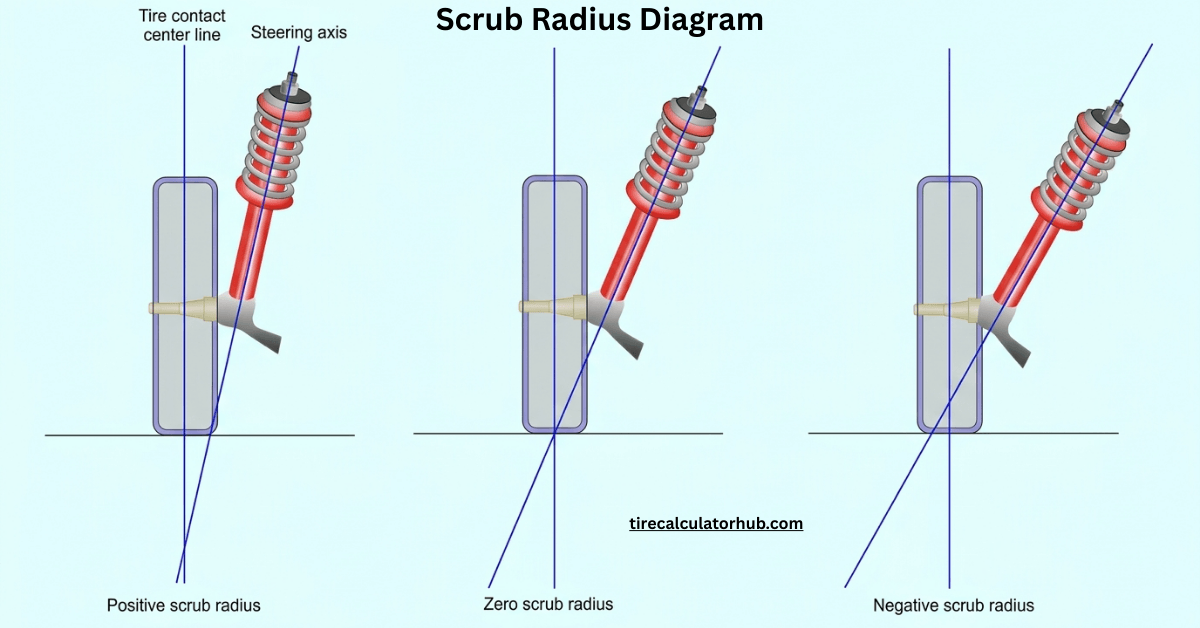
Three variables directly control scrub radius: SAI/KPI angle (fixed by suspension hardpoints), spindle offset (fixed by hub design), and wheel offset ET (changeable by the owner). This calculator exposes that third variable and shows the exact consequence. If a wheel is listed by backspacing instead of ET, the backspacing to offset conversion gives the ET to enter, and the caster angle explainer describes the other tilt of the steering axis.
Frequently Asked Questions
Results are calculated from the values you enter and the formulas shown above. Real-world geometry depends on model year, trim, suspension modifications and component wear. Ask the vehicle manufacturer or a qualified alignment technician whether a wheel offset or spacer is approved before fitting it. TireCalculatorHub is not liable for any damages arising from use of this calculator.